The Browns have one of the best rushing attacks in the NFL. With outside zone being their bread and butter, they have built complementary schemes around it, one of which being Pin/Pull
Pin/Pull is a sweep-style play common in many levels of football. It is a great compliment for outside zone. Depending on the front, different members of the offensive line will be assigned to pull and kick out or pull and lead up for the running back. The Browns are the best team I have studied to date at running Pin/Pull.
For my latest project, I take a week by week game plan view of Kyle Shanahan's offense with the San Francisco 49ers for the 2021 season.
In week 13, the 49ers had game planned a few really neat play action concepts to attack Seattle's defense. The following examples are also included in my latest book.
PLAY 1
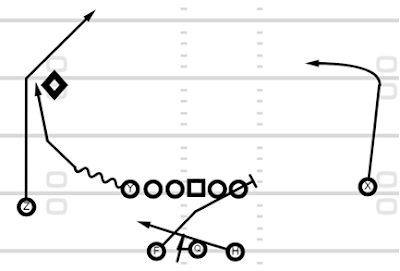
The 49ers featured their Counter – Solid run scheme against the Seahawks
in week 4, and also in this matchup. The next image shows a neat play action
concept off this motion and run action.
The route concept has been in the 49ers playbook for a while now. The tweak is the fast motion and bluff from the F, Kyle Juszczyk. The first off-ball defender is responsible for fitting a new C-gap created if the F slices/kicks the DE, so he has to work downhill and under control with the motion.
Against single high coverage, with the first off ball defender in a bind
and the post clearing out the corner, the bluff-wheel route has a ton of space to
work with down the field. The next image shows how this plays out.
Many of the 49ers play action concepts in this game attacks the seam/flat
player with a run/pass conflict.
The 49ers call this at 1st Q 4:02.
PLAY 2
The next image shows another way the 49ers put the seam/flat player in a
no win situation. The play shows another way to get to the same concept on the
previous page. A bluff-wheel with a bang route on the other side of the field.
In this clip, Kittle (Y) sells like he is arcing for the down safety in a single high structure. He bluffs the safety and gets vertical, having the same effect as the concept on the previous pages.
If the defense has a hard edge (a man outside the Y), Kittle would sell the reach block on this defender before releasing.
PLAY 3
Around 6:30 in the 3rd quarter, the 49ers ran a nice constraint
off their gun 2-back Counter – Solid action. The next image shows the play.
This concept is a combination of a crack toss (without a puller) and
outside zone. I have classified it in the past (and in the 2019 49ers Manual) as
a version of lead outside zone (weak). The 49ers like this concept against
heavy/5-down fronts, especially with a 3 technique set weak. With a 3 technique
weak, this allows for a double team up to the first linebacker.
PLAY 4
The next image shows another fun play action concept from week 13.
This concept is similar in structure to the two previous play action calls.
This time, the bluff-wheel/seam runner comes from inside the new C-gap. Additionally,
the route land marks witch and the bluffer is now the seam route instead of
working up the sideline.
This concept was called at 4th Quarter 12:43
After writing the 2019 San Francisco 49ers Complete Offensive Manual, I wanted to dive deeper into the week to week adjustments and how the 49ers prepare for each specific opponent. the format of this book allowed me to do so, and also explore some fun one-off plays. A few of these examples are included in this article!
The San Francisco 49ers are my favorite offense to study
each offseason. This is made possible by their elite coaching staff and unique
personnel. Their base system allows them to customize their game plan each week
to stress each defense they face.
Since I wrote the 2019 Manual, I’ve
been trying to figure out a way to take a deeper look into their offense beyond
the idea of a concept breakdown. I settled on a game plan format, that will
take the reader week by week through the season. This breakdown is titled Game Planning with the 2021 San Francisco 49ers.
This format builds upon the 2019 Manual, with a baseline
understanding of each concept in the 49er offense, we can take a look at the
weekly variations and tags used to attack specific defenses.
The next image shows one of my favorite examples of this. As
the season went on, defenses started aligning two defenders outside the play
side tackle to stop one of the 49ers base 21/12 personnel outside zone calls by
forcing the ball back inside. Adding the extra tight end allowed the 49ers to
create two double teams and still get the ball outside.
A concept the 49ers liked against heavier fronts,
specifically the Bear front of the Seahawks and the odd/under front of the
Rams, is what I refer to as “Counter-Solid”. The next image shows the play from
week 4.
The offense ends up with two “pullers”, without pulling an
offensive lineman. The fast motion, a critical piece in the 49ers offense in
2021, allows them to do this.
When the 49ers played the Seahawks again in week 13, they
called the play action concept shows in the next diagram. The play looks
identical to their Counter-Solid concept, while at the same time is quite
similar to a pass concept that has been in their offense for years. The flat/seam
defender (FS in the diagram) will be in a trail position on the wheel/rail
route after filling his run responsibility for his first step after the snap.
The next image shows a pass concept the 49ers called in week
9. This play combines a
frontside vertical/hi-low concept with a back side dig concept. The 49ers called this sparingly, but I really liked the design so I wanted to devote a few pages to it.
Against single high, if the weak hook player doesn't work to help on the now-slant from the #1 receiver, the strong hook player is in a high-low. Even if the weak hook player pushes strong, the seam form the tight end (#3) stays on the other side of the field and doesn't bend to the opposite seam. It is a well-designed front side concept.
The next image
shows the concept against cover two, with the will linebacker isolated on the back side after the defense has taken away the front side vertical concept.
This book was a ton of fun to put together. This new format
allowed me to go down some rabbit holes that would just not be feasible in a
manual format. This book is a great resource for coaches who want to improve
their weekly game plans and streamline what they want to focus on. The book is also a great resource for fans who want to learn why the 49ers coaches are some of the best in the league.
Jon Gruden and the Raiders have a few low red zone specific play calls that they like. One particular package revolves around nick/flag nod routes with an underneath return route. They like to call these out of two man snug/stack sets.
The following pages are from my latest book, which breaks down Gruden's entire offensive system from 2020. Pick up a copy on Amazon by Clicking Here.
In an up-tempo environment, Jon Gruden and the Raiders like to run an unbalanced 1-Back Power RPO with the TE on an Arrow route. This concept, which averaged over 8 yards per use for the Raiders in 2020, forces the defense to adjust quickly to an unusual formation.
In week 15, the Chargers adjusted nicely to line up in a sound defense against the concept.
The following screen shots are from my latest Book, which breaks down the entire 2020 Raiders offense. CLICK HERE to get a copy of the book today!
The Packers were a great inside zone team in 2020. Inside zone is a common scheme in the NFL, and is arguably the base run concept in college football.
With their base version of inside zone (no slice block), the Packers averaged over 6 yards per play, and a 90% conversion rate on third down.
Matt LaFleur and the Packers have many ways to gain the numbers back in favor of the offense. Whether it be creative RPO designs or adjustments to the run call, they can always find a way to block up what the defense is presenting.
The following screen shots are my analysis of this scheme from my Book. The Packers Manual breaks down their entire offense in the same manner of their base inside zone scheme below. CLICK HERE to order your copy today.
The 2020 Green Bay Packers Complete Offensive Manual is now available! Get your copy by clicking HERE.
Of all of the NFL offenses I have studied to date, the 2020 Packers are the most translatable to the high school and college game.
Matt LaFleur and his coaching staff put together a run game that features variations of Outside Zone, Inside Zone, and Duo. Here are the percentages of snaps for each of these overall concepts relative to all of the Packers snaps in 2020 (includes RPO's). These three core concepts made up 42% of the Packers offense.
Outside Zone: 18%
Inside Zone: 16%
Duo: 8%
The Packers packaged variations of these concepts each week specific to each defense they were playing. The following clip shows an inside zone RPO used to attack the conflict defender in a two high structure.
The overhang away from the back, in a two high structure, typically will be the conflict defender in most modern defenses. He is the extra fitter in the run game as well as the third member of the triangle coverage to his side. This RPO specifically puts him in a conflict with run action to him as well as the Now screen on his side. Rodgers gets a clean pre-snap read and gets the ball out to the Now.
In the drop back pass game, the Packers ran their offense through Davante Adams. They featured Adams constantly as the first read in Rodgers' progression. The diagram and video below shows how Adams was often isolated opposite the Packers Middle Read - Dagger concept.
The Middle Read - Dagger concept was very multiple for the Packers in 2020. The next diagram and Image show how the Packers incorporated the quick game concept Snag as the front side for the play. Rodgers does an awesome job in the video clip getting to the back side dig route against tight match coverage.
The Packers stood out in 2020 with their red zone production. Each week, LaFleur and his coaching staff had new red zone wrinkles for their opponent. This Book features two red zone sections to focus on these concepts.
The cover image for the book shows the four vertical concept with the RB on the seam route. The Packers loved this concept in 2020 and had a new version almost every week. The book diagrams each one out and discusses the differences in each. One important game plan piece for this concept is the route assigned weak to the single receiver. Often the ball would go here, as this was yet another way to get Davante Adams in a 1 on 1.
High school and college coaches will enjoy the structure of the offense, specifically how the offense eliminated the "fluff" while still having adjustments for each base concept. Both in the run game and pass game. Efficiency at its finest!
The 2017 New England Patriots Pass Game Manual is Now Available! CLICK HERE to order your copy today!
The New England Patriots boasted the most consistent offensive success over the past decade. Marked with exceptional decision making from their future hall of fame quarterback Tom Brady and brilliant play caller Josh McDaniels. By allowing their receivers to have large amounts of "controlled freedom", the Patriots are able to handle more coverages and blitzes with their drop back pass game than most any other team in the NFL.
When we think of the Patriots offense, we think of the famous "Hoss Juke" concept. There's a reason this concept was chosen for the cover image. The Patriots run it often and it is efficient for them. The specific details of the Juke route are explained in great detail. All of the "what if's" from the defense are addressed, showing how this route can win virtually any 1 on 1 matchup and even some 2 on 1 matchups.
While Hoss Juke gets all the attention, the Patriots are just as efficient using the Juke route on the weak side of the formation. The image below shows one of their favorite ways to run it in empty.
This concept, like many within New England's system, is an all-purpose play that can beat most any blitz or coverage.
Not only did I look at 2017 film for this book, I also researched 2012 and 2018 as well. In week 5 of 2012, Wes Welker abused the Broncos defense with the weak side juke route. The cutup below shows some of the better clips from this game.
One of my favorite unique concepts in New England's system is their Dagger-Middle Read-Option concept. The image below shows the base 2-back, most commonly used variation.
The option route on the side of the middle read and dagger route stresses a defense in all directions. This Book goes into extreme detail breaking down how the concept works against all coverages. This section alone has 13 diagrams walking the reader through the progression for the quarterback and how it isolates and attacks different defenders' leverage.
The next video shows a nice 3rd down conversion with this concept against Tennessee in the Divisional round of the playoffs. The Titans bring a "Truck" pressure and play Man-Free behind it. The free release of the running back is critical on this play, as the rest of the receivers are pressed at the line of scrimmage. James White runs a terrific option route and Brady gets to him in his progression right before the well-designed pressure hits home.
The Patriots liked to call this concept on third downs, as you can see in the clip. The average distance to go on 3rd downs for this concept is around 11 yards. The Patriots converted 53% of these third downs with this concept, a staggering number given the usage in long yardage situations.
The Patriots are very unique in how they run their weak side option route. They run it differently than any other team I have studied. How they pair it, read it, and game plan it is worth the study alone. The diagram below shows one variation (of which the book diagrams 16) where it is paired with a Spot-Juke concept. The read for the quarterback when pairing these two concepts is explained in This Book as well:
The video below shows the concept in action vs Brady's new team, Tampa Bay. This Book discusses what Amendola is taught with regard to his technique on this play. On their weak side option route, the Patriots do not allow their receivers to break in (running backs are given different rules out of the backfield). Against man coverage, a stacked receiver will sell the shallow cross before breaking out. In this clip, Amendola's task is made more difficult with the "across" motion rather than "short" motion. He does a great job stemming back inside to win back the outside leverage. Text book teaching tape.
Creating easy completions are important at all levels of the game. The Patriots have a variation on the RB slow screen where the RB will fake a "Nudge" block and pop outside. This play hits faster and will typically generate a higher completion percentage than the traditional slow screen.
The "Nudge" action keeps the play side defensive end from disrupting the throw, like he often does on slow screens. This is a major benefit and a nice tool for the toolbox.
I wanted this book to focus on the "why" behind the design of the concepts more than anything, with the unique nature of the Patriots system. Their offense has something for every coach and fan to take and learn from. Every concept is given its own section, with each variation drawn up, complete down/distance analysis , coaching points, quarterback reads, and what made it effective.