Monday, March 23, 2015

Curl Flat Variations Part 1: Maximize Protection While Attacking the Whole Field


The concept, at its core, involves reading a flat defender, typically an outside linebacker. This becomes dangerous when inside linebackers follow your quarterback’s eyes to the side of the field he is throwing to. The best way to prevent this is to have a “box route”. A box route is a route that hitches between 5-10 yards infront of the center. This route is crucial to the full development of the read.

Curl-flat is known as a ball control type of play. It is not known for its ability to create explosive plays. The curl is the deepest route, and most of the time typically breaks from 8-10 yards at the high school level. Too often the timing of the play is thrown off by poor receiver splits, route technique, and pressure on the quarterback. Too often the receiver running the curl either drifts inside too much or too little.

An adjustment that I have seen throughout the NFL the past few seasons alleviates these problems. The play is run from a pseudo-2x2 bunch formation. #1 reduces their splits to that of a slot receiver, and the slots become H-backs. The H-backs are typically running backs or tight ends. By attaching the slots to the end of the line of scrimmage and the ability to use three running backs/tight ends, this play applies not only to spread teams, but wing-T and flexbone triple option schemes as well. Below is a screen capture of Marc Trestman, the head coach for the Chicago Bears, utilizing this formation against the Detroit Lions.
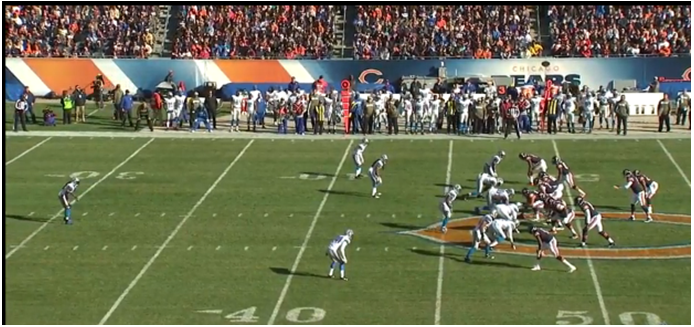

 Credit: NFL.com

The outside receivers will run the curl routes. When pressed, they will attack the outside hip of the corner until he turns his hips, then they will slip inside to get on the same vertical line that they began on. The outside stem typically only lasts for the first 3 yards. If they are not pressed, they will run in a straight line. The depth of the curl will be set at 13-15 yards, depending on how comfortable you are with your quarterback’s arm strength. The receiver will not “curl”, instead he will hitch and drive back to the quarterback for a step or two. This allows the quarterback to throw to a spot and anticipate where the route will be. The design of the route does not allow for interpretation, so the receiver will not have to "find the open window" as he is already in the window. This timing is what will create big plays. The corner will not have as much time to react and the receiver will have more room for yards after the catch.

The H-backs will chip or “nudge” the defensive end before running a flat route. This gives the quarterback more time to throw as well as synchronizes the timing with the break of the curl route. The curl route will break right behind the back of the H-back, optimizing the timing with the quarterback. The running back next to the quarterback will nudge on the inside and run the box route at 5 yards over the center, acting as a check down if the inside linebackers vacate to the curls. If one of the inside linebackers blitz, the running back is responsible for blocking them. If the defense blitzes one of the inside linebackers, there is no need for the box route anymore, as there is either one or zero players that can undercut the two curl routes.

The next screen capture shows the stems of the curl routes about to break as the H-backs are releasing after helping out the offensive tackle. The running back next to the quarterback, Matt Forte, recognizes the 6 man pressure as the middle linebacker blitzes. Forte blocks him instead of releasing to his route and allows the quarterback, Jay Cutler, time to set up for the longer developing curl patterns. Jay reads the outside linebacker and sees that his hips have turned to run with the flat route, opening up the window for the curl.


 Credit: NFL.com

The final screen capture shows Alshon Jeffery high pointing the football as the separation between him and the corner is about 3 yards. This separation is due to the timing of the play, as Jay Cutler threw the ball right behind the vacating outside linebacker following Martellus Bennett to the flat route.


Credit: NFL.com

 The curl-flat concept has been in football for a long time, but a couple of tweaks to the classic version of the play can create more efficiency along with big play potential. This version can be utilized in any offensive system and requires less teaching than the original version of the play.

Monday, March 9, 2015

How the Patriots Dinked and Dunked their way to a Superbowl Title


After a brief hiatus, I am back to blogging. Studying for the FE exam has taken up a significant portion of my free time the past couple months.

The 2014 Patriots displayed one of the more diverse NFL offenses I have seen in my relatively short life. They displayed the ability to run the ball with two tight ends and a full back, and the next play go empty and let Tom Brady pick apart the secondary. For that reason, this offense has been one of the focal points of my offseason study.

The Patriots can have this diversity due to the repetition of play calls. Over the course of five games that I looked at, the same base concepts appeared more often than a typical NFL team uses their base plays. With opposing defenses knowing this information, the seeming lack of variety must be made up for diversity within each concept. The play that I am going to talk about is an example of this.


The play is called out of an empty set. The core concept is a standard cover 3 beater used by teams at all levels, seam-hitch. The inside receiver to the trips side runs an option route. He will sit over the middle if there is a void. If he feels pressure, he will instead run across the field on a drag route.

Against a single high defense, the two inside linebackers provide the initial post snap read for the quarterback. Their hips won’t lie, if they stay square, move on to the outside combination. If they open their hips and turn upfield, the quarterback will have the option route. Against a cover 3, the middle hook will typically be the choice of the receiver, as in the figure below, a natural void between the two inside linebackers opens up. The figure below also shows the Baltimore Raven’s linebackers staying square, and Brady’s eyes have already moved on to the vertical route.


The initial read on the inside linebackers occurs in the split second after the quarterback gets the ball. It is vital that this decision takes place before the slot receivers get to 10 yards, as anything longer allows the defense to adjust to the concept. Brady then reads the seam-hitch concept, reading the outside linebacker’s hips.

The next figure shows the defense as Brady has released the ball. (On a side note: look at how quick his delivery is. The receivers have only taken two steps in the time it took Brady to read the flat defender and complete his throwing motion!)  


The next example shows the same concept against a two high defense. Against this defense, the quarterback will key the option route. The two deep safeties create a 3 on 2 matchup in favor of the defense on the outside, however they expose their middle linebacker in a 1 on 1 matchup against a speedy slot receiver.


The Colts bring a blitz, the WLB rushes and the right defensive end drops to the hook on the opposite side. The protection scheme does not account for the WLB, however Brady gets rid of the ball with proper timing. This timing does not allow a delayed blitz to get to him before he releases the ball. The second figure below was taken as the ball is approaching the inside receiver on the trips side running the drag route.  


Brady’s timing is a result of his high intellect along with lots of repetition. Timing can be created by practicing the concept over and over against different looks from the defense, occasionally mixing in random blitzes and coverage rolls. If the quarterback has seen it in practice, he will have the knowledge of how to account for it in a game.

The option route must be taught properly and ran by the proper player. The option route must be ran by a speedy slot type that can separate from a linebacker in man coverage. The receiver must not take long at the top of the route, he should make his decision halfway through the stem. If the receiver elects to run the drag route, he must not look until he has clearly made his cut to continue across the field. This ensures that the quarterback knows which option he has chosen.

Using an option route within an existing core concept can create opportunities against more varieties of coverages. I would love to hear about what option routes you may use/like with certain concepts, Email me at bpeters1212@gmail.com or comment below!

Friday, January 23, 2015

How Oregon Uses a Sweep Play to Constrain Defenses


Two weeks ago this blog reached 1,000 page hits. Thank you for your support and I hope my articles are worth your time!

Oregon uses inside zone as their main running scheme. My previous article details an example of this, with the quarterback running it in an empty backfield.


Oregon will use the inside zone scheme over and over when they are operating at a high tempo. Naturally, the Ducks use a sweep play to keep the defense from keying on their base scheme. The figure below shows Oregon lined up in a formation that they typically use for their inside zone scheme with a bubble screen attached. The play diagrammed is a sweep play that the Ducks like to use to the closed side of the formation. Up to this point in the drive, the Ducks has successfully used inside zone multiple times.


Mariota is reading the #3 defender at the top of the screen to see if he should throw the bubble. Florida State accounts for all three receivers and Mariota properly hands the ball off.

The linebackers are sent on an inside run blitz in order to be in a better position for the inside zone scheme. The Ducks guessed right, as you can see in the figure below, the linebackers are unblocked and will not make a play on the running back.


 Both the right guard and the center will lead through the C gap. The center peels back to pick up one of the blitzing linebackers. As you can see below, the running back has plenty of space to operate in.


It is important to make your secondary plays look like your base scheme, both in formation and initial movements. Your secondary plays must create hesitation in the defenders that are disrupting your main plays. Your secondary plays serve to take advantage of nosy defenders for big plays as well as open up your base scheme.

Monday, December 15, 2014

Play of the Day: Dan Mullen Adjusts to Auburn's Cover 0


The play is taken from The Mississippi State vs. Auburn game earlier this season. Auburn had been giving Mississippi State Cover 0 on third down most of the game up to this point. This defense is called in anticipation of a longer pass concept. It is designed to create pressure quickly and force an early throw short of the sticks. Dan Mullen picks up on this and decides to run an inside zone scheme out of empty with attached bubble screens. The play is diagrammed below.


The attached bubble screens ensure that the defense allocates five defenders to cover the five receivers. If the defense decides to blitz off the slot, Prescott has the option to throw to the uncovered slot. The inside zone scheme leaves the backside defensive end unblocked, which creates a 5 on 5 matchup for the offensive line. The key block against this defensive front is the right tackle getting inside of the 3 technique to seal him off.


The next figure shows the right tackle working down the line of scrimmage to cut off the 3 technique, as well as the other developing blocks.


The next figure will give any offensive line coach a tingle. The right tackle has sealed the 3 technique. The center is double teaming the front side 3 technique that has stunted inside,  and will eventually work up to the inside linebacker.


The last figure shows the center about to seal off the front side inside linebacker, creating a hole that Dan Mullen himself could run through. The play results in a touchdown.


I have always been a fan of the Dan Mullen – Urban Meyer style of spread offense. It is a mutt of many old pro-style 2 back schemes mixed with option football. I want to spend more time analyzing both Meyer and Mullen this past season and see how the offenses have evolved and what Tom Herman has brought to it as well. If you have any resources on them please leave it in a comment, I would appreciate it.

Monday, December 8, 2014

Play of the Day: Shake Route


The Arizona Cardinals used the “Shake” route to take a shot down the field against the Detroit Lions.  This play takes advantage of the safety cheating the corner route. The shake route, run by the Z receiver, is the primary receiver. If the defense is in a two-high safety look, the Z will take a hard inside release to press the outside hip of the safety vertically. The point of the catch should be the middle of the field. If the defense is in a single-high safety, the Z will not take as hard of an inside release. This ensures that the route will end up in the seam between the corner and the safety.


 NFL.com


The next figure shows the releases of the wide receivers. It is important that the Z receiver attacks far enough inside to create a two way threat against the safety.


NFL.com


The third figure shows the Z receiver after he has made his outside cut. You can see that the safety has turned his hips to react to the outside breaking cut. This is the quarterback’s indicator that the shake route will be open. The Z receiver then makes his inside cut, crossing the safety’s face. It is Important to have a vertical release on the other side of the field to keep the other safety occupied.

 
NFL.com

The last figure shows when the ball should be arriving.

 
NFL.com


This play should only be used sparingly, as its effectiveness diminishes each time it is used. Having an arsenal of explosive plays that can be used throughout a game is vital to the success of any team. This play also breaks any route reading tendencies the defense may have been leaning on.