Tuesday, June 9, 2015
WTBMC #4: Out and Go
The Steelers used a double move against a version of man coverage on third and short. The double move is an out and go route from a bunch alignment. The defense will typically trigger on any routes at the sticks on third down, this makes a double move a great call. The link to the video is below.

Friday, June 5, 2015
WTBMC #3: Jailbreak Screen
The Steelers used a jailbreak screen against a man look from the Cleveland Browns. There are a couple of subtle differences in this play from most jailbreak screens. The ball is thrown to the slot receiver instead of the outside receiver. The slot will sell the bubble in his first few steps. This fake will put the defender in a trail position for the jailbreak screen. A releasing offensive lineman will also block this defender. The video can be seen by clicking the link below.
https://www.youtube.com/watch?v=gg8ubsF2Zvo
https://www.youtube.com/watch?v=gg8ubsF2Zvo
Wednesday, June 3, 2015
Ways to Beat Man Coverage #2
This play is great for short yardage. The inside receiver in a trips set will "return" motion to running a flat route. The two outside receivers will run slant routes at varying depths to pick the man on the flat route.
https://www.youtube.com/watch?v=oBWpvrI6M38
https://www.youtube.com/watch?v=oBWpvrI6M38
Friday, May 22, 2015
Ways to beat man coverage "WTBMC"
"WTBMC" will be a series of film clips on how to beat man coverage. The first clip in the series is of the Patriots against the Broncos in 2014. The Patriots run a pick-wheel route to the running back out of the backfield. Enjoy!
https://www.youtube.com/watch?v=z9AMbDbjmqw&feature=youtu.be
https://www.youtube.com/watch?v=z9AMbDbjmqw&feature=youtu.be
Monday, April 27, 2015
Play of the Day: Detroit Lions' "Chair" Route
I saw this play during the Lions-Cowboys playoff game during the
2014 season. This play takes advantage of a lose man coverage. The play is
shown below:

The route combination benefits from max protection. The quarterback
will need an extra few seconds for the chair route to develop. The outside
receiver will run a skinny post route. This route will draw the attention of
the single high safety, especially when it is run by Calvin Johnson. The chair
route is run by the slot. The next figure was taken right after the slot made
his out cut:

The large cushion given
by the man guarding the slot allows the slot to cross his face. This is what
makes the play successful. If the slot was guarded in a press look, he would
have little to no space to cross the defender’s face. This “chair” technique can be a
good adjustment for a team that runs a lot of wheel-post combinations that see
off coverage on the slot. Defenses like to play off coverage against a wheel,
as it gives them a better chance of not letting the wheel get behind them.
The next figure shows the slot making his double move,
crossing the defender’s face.

The final figure shows where the ball was caught.

If you run a lot of wheel-post, this adjustment can take
advantage of what the defense thinks is a conservative coverage. Never settle,
always look for a way to attack!
Monday, March 23, 2015
Curl Flat Variations Part 2: Adjusting Routes to Attack Cover Two
This article
expands on my previous article, Part 1. The link is provided below.
http://theofficialpetersreport.blogspot.com/2015/03/curl-flat-variations-part-1-maximize.html
This article will focus on adjusting the play to better
attack two high defenses and man coverage where corners are in a trail
technique, such as man under two deep. The adjustment consists of the receivers
that are running the curl route to read the corner back (will be referred to as
CB to alleviate confusion with the corner route). If the CB trails or drops off
to the flat, the receiver has the option of running a corner route at a depth
of 10-12 yards. This adjustment turns the play into the traditional smash
concept, a high-low read on the CB. This small route adjustment creates a play
that contains two of the more popular passing concepts in the country. Putting
the two concepts into the same play minimizes verbiage and teaching time.
With this adjustment, the quarterback will now read the CB
instead of the outside linebackers. If the CB is trailing the receiver or jumps
the flat route, the quarterback throws the corner route. If the CB plays off
and keeps everything in front of him, the quarterback looks for the open window
to the curl route. If the window is tight, that means he has the flat route as
a check down.
An important coaching point when installing this concept is
establishing the main objective of the option route. If the defender is in a
position where he can play both the curl and the corner, which route should the
receiver run? The answer can vary based on your quarterback’s preference to
which route he likes better, or which route requires more anticipation.
Typically a curl route requires more anticipation, as the quarterback can see
the corner cut and still make the throw. If he waited for the curl to break
before he threw, it is often times too late.
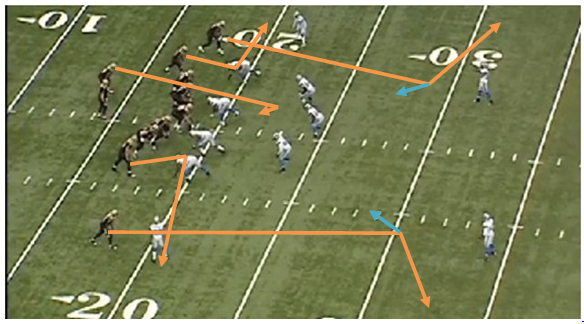
Below are a series of screen captures of the New Orleans
Saints using this concept. I am not sure if they teach it as an option route,
but for our purposes it gets the job done. The first figure shows the
formation, the same as described in the previous article along with the play
diagrammed.

Credit: NFL.com
In the next figure, you can see the CB at the bottom pass
off the vertical release to react to the flat route.

Credit: NFL.com
In the final figure, the receiver breaks to the corner. Good route technique against a two high defense requires the corner route to flatten away from the safety.


Credit: NFL.com
Making small adjustments to your base plays can give your
players a better chance to succeed against a wider range of coverages.
Combining concepts is also a good way to minimize verbiage and allow the
players to practice less plays more frequently, all while having answers to
what the defense does.
Curl Flat Variations Part 1: Maximize Protection While Attacking the Whole Field
The concept, at its core, involves reading a flat defender, typically an outside linebacker. This becomes dangerous when inside linebackers follow your quarterback’s eyes to the side of the field he is throwing to. The best way to prevent this is to have a “box route”. A box route is a route that hitches between 5-10 yards infront of the center. This route is crucial to the full development of the read.
Curl-flat is known as a ball control type of play. It is not
known for its ability to create explosive plays. The curl is the deepest route,
and most of the time typically breaks from 8-10 yards at the high school level.
Too often the timing of the play is thrown off by poor receiver splits, route
technique, and pressure on the quarterback. Too often the receiver running the
curl either drifts inside too much or too little.
An adjustment that I have seen throughout the NFL the past
few seasons alleviates these problems. The play is run from a pseudo-2x2 bunch
formation. #1 reduces their splits to that of a slot receiver, and the slots
become H-backs. The H-backs are typically running backs or tight ends. By attaching
the slots to the end of the line of scrimmage and the ability to use three
running backs/tight ends, this play applies not only to spread teams, but
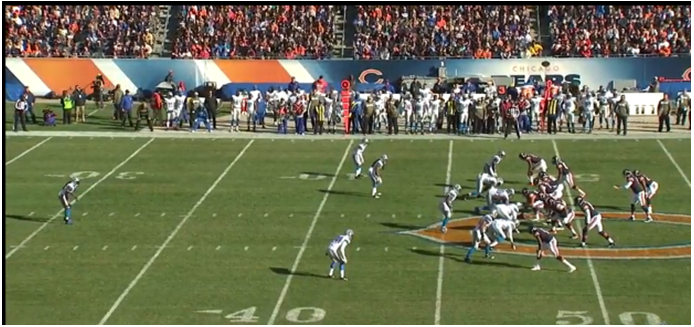
wing-T and flexbone triple option schemes as well. Below is a screen capture of
Marc Trestman, the head coach for the Chicago Bears, utilizing this formation
against the Detroit Lions.

Credit: NFL.com
The outside receivers will run the curl routes. When
pressed, they will attack the outside hip of the corner until he turns his
hips, then they will slip inside to get on the same vertical line that they
began on. The outside stem typically only lasts for the first 3 yards. If they
are not pressed, they will run in a straight line. The depth of the curl will
be set at 13-15 yards, depending on how comfortable you are with your
quarterback’s arm strength. The receiver will not “curl”, instead he will hitch
and drive back to the quarterback for a step or two. This allows the
quarterback to throw to a spot and anticipate where the route will be. The
design of the route does not allow for interpretation, so the receiver will not
have to "find the open window" as he is already in the window. This
timing is what will create big plays. The corner will not have as much time to
react and the receiver will have more room for yards after the catch.
The H-backs will chip or “nudge” the defensive end before
running a flat route. This gives the quarterback more time to throw as well as
synchronizes the timing with the break of the curl route. The curl route will
break right behind the back of the H-back, optimizing the timing with the
quarterback. The running back next to the quarterback will nudge on the inside
and run the box route at 5 yards over the center, acting as a check down if the
inside linebackers vacate to the curls. If one of the inside linebackers blitz,
the running back is responsible for blocking them. If the defense blitzes one
of the inside linebackers, there is no need for the box route anymore, as there
is either one or zero players that can undercut the two curl routes.
The next screen capture shows the stems of the curl routes
about to break as the H-backs are releasing after helping out the offensive
tackle. The running back next to the quarterback, Matt Forte, recognizes the 6
man pressure as the middle linebacker blitzes. Forte blocks him instead of
releasing to his route and allows the quarterback, Jay Cutler, time to set up
for the longer developing curl patterns. Jay reads the outside linebacker and
sees that his hips have turned to run with the flat route, opening up the window
for the curl.


Credit: NFL.com
The final screen capture shows Alshon Jeffery high pointing
the football as the separation between him and the corner is about 3 yards.
This separation is due to the timing of the play, as Jay Cutler threw the ball
right behind the vacating outside linebacker following Martellus Bennett to the
flat route.


Credit: NFL.com
The curl-flat concept has been in football for a long time,
but a couple of tweaks to the classic version of the play can create more
efficiency along with big play potential. This version can be utilized in any
offensive system and requires less teaching than the original version of the
play.
Subscribe to:
Posts (Atom)