The 2020 Green Bay Packers Complete Offensive Manual is now available! Get your copy by clicking HERE.
Of all of the NFL offenses I have studied to date, the 2020 Packers are the most translatable to the high school and college game.
Matt LaFleur and his coaching staff put together a run game that features variations of Outside Zone, Inside Zone, and Duo. Here are the percentages of snaps for each of these overall concepts relative to all of the Packers snaps in 2020 (includes RPO's). These three core concepts made up 42% of the Packers offense.
Outside Zone: 18%
Inside Zone: 16%
Duo: 8%
The Packers packaged variations of these concepts each week specific to each defense they were playing. The following clip shows an inside zone RPO used to attack the conflict defender in a two high structure.
The overhang away from the back, in a two high structure, typically will be the conflict defender in most modern defenses. He is the extra fitter in the run game as well as the third member of the triangle coverage to his side. This RPO specifically puts him in a conflict with run action to him as well as the Now screen on his side. Rodgers gets a clean pre-snap read and gets the ball out to the Now.
In the drop back pass game, the Packers ran their offense through Davante Adams. They featured Adams constantly as the first read in Rodgers' progression. The diagram and video below shows how Adams was often isolated opposite the Packers Middle Read - Dagger concept.
The Middle Read - Dagger concept was very multiple for the Packers in 2020. The next diagram and Image show how the Packers incorporated the quick game concept Snag as the front side for the play. Rodgers does an awesome job in the video clip getting to the back side dig route against tight match coverage.
The Packers stood out in 2020 with their red zone production. Each week, LaFleur and his coaching staff had new red zone wrinkles for their opponent. This Book features two red zone sections to focus on these concepts.
The cover image for the book shows the four vertical concept with the RB on the seam route. The Packers loved this concept in 2020 and had a new version almost every week. The book diagrams each one out and discusses the differences in each. One important game plan piece for this concept is the route assigned weak to the single receiver. Often the ball would go here, as this was yet another way to get Davante Adams in a 1 on 1.
High school and college coaches will enjoy the structure of the offense, specifically how the offense eliminated the "fluff" while still having adjustments for each base concept. Both in the run game and pass game. Efficiency at its finest!
The 2017 New England Patriots Pass Game Manual is Now Available! CLICK HERE to order your copy today!
The New England Patriots boasted the most consistent offensive success over the past decade. Marked with exceptional decision making from their future hall of fame quarterback Tom Brady and brilliant play caller Josh McDaniels. By allowing their receivers to have large amounts of "controlled freedom", the Patriots are able to handle more coverages and blitzes with their drop back pass game than most any other team in the NFL.
When we think of the Patriots offense, we think of the famous "Hoss Juke" concept. There's a reason this concept was chosen for the cover image. The Patriots run it often and it is efficient for them. The specific details of the Juke route are explained in great detail. All of the "what if's" from the defense are addressed, showing how this route can win virtually any 1 on 1 matchup and even some 2 on 1 matchups.
While Hoss Juke gets all the attention, the Patriots are just as efficient using the Juke route on the weak side of the formation. The image below shows one of their favorite ways to run it in empty.
This concept, like many within New England's system, is an all-purpose play that can beat most any blitz or coverage.
Not only did I look at 2017 film for this book, I also researched 2012 and 2018 as well. In week 5 of 2012, Wes Welker abused the Broncos defense with the weak side juke route. The cutup below shows some of the better clips from this game.
One of my favorite unique concepts in New England's system is their Dagger-Middle Read-Option concept. The image below shows the base 2-back, most commonly used variation.
The option route on the side of the middle read and dagger route stresses a defense in all directions. This Book goes into extreme detail breaking down how the concept works against all coverages. This section alone has 13 diagrams walking the reader through the progression for the quarterback and how it isolates and attacks different defenders' leverage.
The next video shows a nice 3rd down conversion with this concept against Tennessee in the Divisional round of the playoffs. The Titans bring a "Truck" pressure and play Man-Free behind it. The free release of the running back is critical on this play, as the rest of the receivers are pressed at the line of scrimmage. James White runs a terrific option route and Brady gets to him in his progression right before the well-designed pressure hits home.
The Patriots liked to call this concept on third downs, as you can see in the clip. The average distance to go on 3rd downs for this concept is around 11 yards. The Patriots converted 53% of these third downs with this concept, a staggering number given the usage in long yardage situations.
The Patriots are very unique in how they run their weak side option route. They run it differently than any other team I have studied. How they pair it, read it, and game plan it is worth the study alone. The diagram below shows one variation (of which the book diagrams 16) where it is paired with a Spot-Juke concept. The read for the quarterback when pairing these two concepts is explained in This Book as well:
The video below shows the concept in action vs Brady's new team, Tampa Bay. This Book discusses what Amendola is taught with regard to his technique on this play. On their weak side option route, the Patriots do not allow their receivers to break in (running backs are given different rules out of the backfield). Against man coverage, a stacked receiver will sell the shallow cross before breaking out. In this clip, Amendola's task is made more difficult with the "across" motion rather than "short" motion. He does a great job stemming back inside to win back the outside leverage. Text book teaching tape.
Creating easy completions are important at all levels of the game. The Patriots have a variation on the RB slow screen where the RB will fake a "Nudge" block and pop outside. This play hits faster and will typically generate a higher completion percentage than the traditional slow screen.
The "Nudge" action keeps the play side defensive end from disrupting the throw, like he often does on slow screens. This is a major benefit and a nice tool for the toolbox.
I wanted this book to focus on the "why" behind the design of the concepts more than anything, with the unique nature of the Patriots system. Their offense has something for every coach and fan to take and learn from. Every concept is given its own section, with each variation drawn up, complete down/distance analysis , coaching points, quarterback reads, and what made it effective.
The 2019 San Francisco 49ers Complete Offensive Manual is now Available. CLICK HERE to order your copy today!
The San Francisco 49ers offense, under the direction of Kyle Shanahan, is one of the most diverse offenses in the NFL. Every year, regardless of personnel, Shanahan and his staff put their players in a great position to succeed.
The base of the 49ers offense is the outside zone scheme. They will run it out of every personnel grouping, and every formation in their playbook. This book covers each variation used throughout the season.
Their most commonly used outside zone play is the "Strong - Lead" version called out of 21 personnel. With the running back's aim point being directly in line with blocking aces George Kittle and Kyle Juszczyk, Shanahan used his personnel strengths wisely. This year, I added a new layer of analysis to this book as opposed to previous books. Each run/pass play is broken down by fronts/coverages it faced throughout the season, in addition to my traditional situational play calling charts. Below is the Front table for "Outside Zone - Strong - Lead" as well as a base diagram against an Over front.
The run game for the 49ers is the most diverse & complimentary scheme I have studied to date. Their system has a way of featuring outside zone, while being really good at gap schemes too. The complimentary plays for both their zone and gap schemes are critical to their overall success as well. High school and college coaches will enjoy these sections, as they provide the road map for a successful ground game.
Shanahan's system is well-known for its ability to create chunk plays down the field with play action.This book explains the different ways he goes about this. The diagram and video below show a unique twist on a three level flood concept. The play was called against the LAR quarters coverage. Lining up in 12 personnel with Kittle at the "F" and delay releasing the Y, the 49ers are able to isolate Kittle on the intermediate route vs a conflicted LB. This adjustment removes the quarters safety, as he is taught to go rob the #1 receiver.
Shanahan is great at getting the ball out of the quarterbacks hands quickly through a variety of creative ways. The image/video below shows a "Mini Jerk - Stutter Slant" concept that created some big plays in 2019. The play attacks similar landmarks as the traditional 2-man drive concept, but it gets the ball out of the quarterback's hands much quicker.
Shanahan's expansive "Choice" package is one of my favorite aspects of his offense. The Choice route gives the tagged receiver a three way go, with the surrounding routes as ways to punish the defense if they bracket the Choice as the primary read. The image/video below show one of my favorite variations he used in 2019. The four verticals with switch-releases give a nice downfield attacking concept, and often clears space for the choice route to work 1 on 1.
Shanahan has multiple ways to protect the Choice concept. One example is tagging the "Bang Dig" behind the Choice route. When the defense brackets the choice route, the dig window is huge. The image/video below shows one great example form their week 14 point explosion vs New Orleans.
I could go on and on, but that's what the 343 page book is for. Shanahan's system has something for every coach/fan to learn from. Whether it be run game, drop back pass game, extensive play action package, or creative screen calls (throwback screens!), every play design is well thought out and has a purpose for the 49ers.
Learn from one of the NFL's top offensive minds with this book. Every concept is given its own section, with each variation drawn up, complete statistical analysis (including vs fronts/coverages), coaching points, and what made it effective.
With the Bears finishing 8-8, many people are quick to assign blame for the NFL's 29th ranked offense.
As someone who has literally written a book about Matt Nagy's system, I can speak to many of the nuances that we see on tape. The most glaring problem with the Chicago Bears in 2019 was the regression from their 3rd year quarterback. With a defense that was set to regress after an insane 2018 season, the quarterback was supposed to pick up the slack. Everybody else on offense (yes, including Allen Robinson's blocking at times) contributed to the Bears' struggles. From an offensive production standpoint, I place the least amount of blame on Nagy's play calling/ play design (I will get into my other issues with Nagy later on).
There are a few misconceptions that need to be aired out regarding the Bears offense in 2019. In the wonderful world of social media, when somebody with a lot of followers tweets or writes something, people tend to grab onto it. Here is a systematic look at every talking point that surrounded the Bears' struggles in 2019, most of which I do not subscribe to: "Matt Nagy needs to give up play calling duties."
One of the prevailing bases for this statement is people's belief that he abandons the running game. While there is a degree of truth to this, we can not use this as a foundation for our desire to change play callers. We saw what that offense looked like in week 2 at Denver, when Nagy featured the ground game heavily. The Bears managed 16 points, with a paltry 62 yards for their leading rusher, David Montgomery.
Nagy actively tried to fix the running game as well. This was an interesting case study when we compare it to the 2018 version of the offense. In 2018, Nagy paired back the amount of run schemes they used to focus more on inside/outside zone. This seemed to help the offensive line. In 2019, Nagy continued that trend. As the season went along, he started to add in more and feature gap schemes at times in order to fix the 2019 problem. Nothing seemed to work. The offensive line consistently struggled with every run scheme.
At times when the San Francisco offense abandoned the running game in 2019 (week 11 vs ARI), are we calling for Kyle Shanahan to give up play calling duties? Absolutely not.
Without a solid starting quarterback in 2017 and 2018, Kyle Shanahan's offense was not producing enough to the point where people were calling for him to be fired. With a healthy Jimmy Garoppolo in 2019, the 49ers are 2nd in scoring. Did Shanahan become a significantly better coach overnight? No. He schemed guys open in 2017/2018 as well, similar to what Nagy did in 2019.
From a scheme design standpoint, I thought the Bears had a good game plan for the run game most weeks. Execution lacked most of the time from the offensive line and running backs. Here is a video I made discussing a neat adjustment he used week 5 vs Oakland. This adjustment took place between drives, which is impressive. The clip of the play is below my breakdown link. The rough back block from the left guard prevents this play from taking off for a big gain: https://twitter.com/b_peters12/status/1186037571836616706?s=20
"Matt Nagy needs to call more play action"
There is a degree of truth to this, but this statement can not be applied in a vacuum. Nagy went into 2019 with the understanding that his quarterback would be better in year 2 of HIS system. They focused on what they were good at in 2018, and worked on expanding/protecting that over the off season. According to Football Outsiders, The Bears were more efficient with standard drop backs in 2018 as opposed to play action. You can debate whether this is a fair assumption or not, but every coach in this situation would do the same thing.
When people want to point to a situation like the Minnesota Vikings, we can clearly see that the system did help Cousins play better. But at the end of the day, how many more games did the Vikings win because of it? The answer is 1.5 (they had a tie). The Vikings also played a first place schedule in 2018. A limited Quarterback is still the limiting factor. Also, for what it's worth, Kirk Cousins is a decidedly better quarterback than Mitch Trubisky, so the results might not necessarily be the same.
With not much work on it in the off season, it is hard to make wholesale scheme changes like this mid-season. What is the better alternative? Scrap what you have been working on for a year and a half, or continue to work on it to iron out the kinks? I find it hard to condemn Nagy for a flaw that very few people identified when the offense had answers most of last year.
With the advanced analytical data we have available, it is fair to criticize Nagy for not adding more of this to his system in the off season. Andy Reid uses it often as well. Nagy seems to have taken that element of the offense in a different direction. Let's be clear, This is not a fireable offense. He can certainly learn from this. After all, this is his second season calling plays. No play caller is mistake-free in their second season.
When Nagy did add more play action just after mid-season, Mitch still struggled with it. Here is a cutup that shows the issues that still persisted.
"Nagy needs to get Mitch out of the pocket more"
Straight sprint-outs and nakeds severely limit how the offense can attack. They are fine if used a few times a game to move the launch point for the O-Line or take a shot downfield, but they can not be the identity of an NFL offense. The Table below shows how the action was not effective for the Bears in 2019. They were called a total of 46 times.
Here is a cutup of some of the less-effective ones.
The main takeaway here is that sprint outs and nakeds are not the answer for limiting Trubisky's pocket issues. They were in fact less efficient than most of their drop back pass concepts. The timing and accuracy issues still persisted. "Nagy just needs to pound the rock with Montgomery on 3rd and short" On straight ahead run plays (including QB sneaks), the Bears converted 63% on 17 attempts of their third/fourth and 1-2 yards. When throwing, the Bears converted 56% on 16 attempts. From a play calling perspective, game flow can often dictate these calls more than conversion rates, because of the small difference in probability. Without a tangible difference in conversion rate, the Bears wanted to be balanced in these situations to prevent a defense from overplaying the run.
I would like to see more QB sneaks on third and 1. That is the most efficient play in football. Nagy does use it, I would just like to see it a little more. The Bears were 3/4 with sneaks in 2019. "Nagy needs to run the ball under center more"
Through week 11, after the Bears got through their roughest part of the season, they averaged more yards per carry running from shotgun than from under center.
In The Nagy/Reid/Peterson offense, the run game is heavily based in RPO reads for the quarterback. This keeps the offense from having to run into bad looks and overloaded boxes. RPO's are usually ran from shotgun to help the quarterback see his post-snap read. At times in 2018 (think week 14 vs LAR) Nagy did some extreme simplification mid-game to adjust for Trubisky's struggles. In these situations, he leaned heavy on RPO's.
With that said, Trubisky still struggled with these reads at times. RPO's are much simpler than traditional drop back pass concepts for quarterbacks. They are, quite literally, made for "One Read" quarterbacks. Most of them require to read a single defender as his run/pass key. Trubisky has proven over the course of two years that he can not consistently do this. Here is a cutup of simple RPO reads gone wrong. I marked these as Trubisky having misread the keep/give action or the run/pass element. One inaccurate throw included as well.
If Trubisky can't handle RPO reads, there really isn't much left that Nagy can do to help him.
In the drop back pass game, Trubisky has struggled as well. In their post-season press conference, Nagy said that Mitch needs to understand/read coverages better in 2020 (an alarming thing to say about a 4th year NFL QB). Here is a twitter thread I put together of a few examples Nagy is talking about: https://twitter.com/b_peters12/status/1213178025266831370?s=20
Matt Nagy
There are situations that Matt Nagy is responsible for, as the Head Coach and Offensive play-caller. Here are a few that, in my opinion, can be fairly assessed to him:
His willingness to settle for long field goals at end of game situations. Regardless of how good your kicker is, you should make his job as easy as possible. One example of this is the end of the Chargers game, where he elected to not even run the ball, but instead kneel to bring out his kicker for a long field goal attempt.
The 3rd and 1 vs the Rams. My issue does not lie with the design of the play (speed option to the short side of the field), it lies with the fact that Trubisky was injured, and Montgomery was lined up in a pistol set 9 yards behind the line of scrimmage. The design of the play worked. If Trubisky does his job and attacks the EMOLS (end man on the line of scrimmage), the Bears pick up the first down.
In general, I felt a sense of complacency with the team that we did not feel in 2018. Coming off a 12-4 season, this is what the head coach needs to be fighting against.
All of the above mentioned items are areas that Nagy can improve at if he is honest with himself. At this point. The same can not be said for Trubisky.
The positives far outweigh any negatives for Nagy. Changing the culture of the organization and bringing in a well-designed offense are not to be taken lightly. If you fire Nagy, who are you hiring to replace him?
It goes without saying that this off season is huge for Nagy/Pace. What will they do to address the quarterback position? If they choose to do nothing tangible, the positives will not outweigh the negatives at this time next year.
*All stats are from weeks 1-16. With the Vikings not playing their starters in week 17, that data was thrown out.
I have discussed Matt Nagy's HB Read package on twitter quite a bit this off season. It was probably my favorite aspect of his offense, or any offense I studied.
I created a thread a few months ago. I made this post so you could easily find them in one place.
This call takes advantage of the defense trying to cover the option route 1on1 playing tight inside leverage. The defense is trying to force the out cut and limit the effectiveness of the option route. Against this type of coverage, the "Whirl" concept can create big plays. This was one of the Bears most efficient play calls in 2018, averaging 15 yards per play.
The "Bang" tag is a great way to slice the intermediate level of the defense if the option route gets the attention of inside linebackers. Additionally, if the defense is trying to play the corner route from #1 weak with the safety, the dig will be able to get inside leverage easily.
At any level of football, red zone efficiency is paramount. In the NFL these days, most teams don't have much trouble moving the ball between the 20's. The contending teams separate themselves with converting touchdowns in the red zone.
With a quarterback like Aaron Rodgers, a well designed play in the red zone can be a money machine. Introduce new head coach Matt LaFleur's go-to red zone call. In the Titans Passing Index, I refer to this concept as "Double Post Whip". The play is diagrammed below:
The concept is designed to look like the slot receiver is "picking" the corner, in order to free up the outside receiver on a slant pattern. A "Fake Pick", if you will. With all of the man coverage played in the red zone, NFL defenses see plenty of pick plays in those situations. This play takes advantage of defenses expecting the pick action. The progression for the quarterback is as follows:
Inside Post
Outside Post
Whip
While with Tennessee, this play was by far Matt LaFleur's go to call in the deep red zone (10-20 yards to go). He also used this play in the shallow red zone (10 yards and in). Additionally, it was his most common third down passing concept. The usage and efficiency chart from my book, The 2018 Tennessee Titans Passing Index, is below:
While not efficient for the modest Titans passing attack, there are a few good examples of why this concept is well-designed.
VS True Man
The video below shows the only touchdown thrown to the outside post in 2018:
Philadelphia plays a "lock and level" man coverage. Pressing one receiver while playing off coverage on the other reduces the impact of picks and rubs. The #2 receiver uses a "throw-by" technique to gain inside leverage for his post route. With the slot fade as a common red zone route from a #2 receiver, defensive backs will typically play the wide release over the top to contest the route. If the slot fade is a staple in your offense, this play is a nice compliment to it.
One of the most important coaching points is how to gain inside leverage on the outside post route. The Titans struggled with this in 2018. The video below shows an example:
To find some good examples of the proper route technique, I looked at LaFleur's mentor, Kyle Shanahan, for some tape. Although Kyle does not run it as often, it is in his playbook. The videos below show great technique from the #2 receiver to gain inside leverage on a man defender.
Even with proper technique, the slot can still have a hard time winning inside. If all else fails, the whip route is a nice bail out for the quarterback. The video below shows a great example of this. The outside post is covered up nicely, and the whip route gains leverage. A better throw would have allowed the offense to pick up a first down.
VS Catch Man
Another response is for defenses to play catch-man. Against this technique, the defense can switch coverage on the releases of the #1 and #2 receiver. The video below shows how this concept looks against this technique.
The #2 receiver now has inside leverage for his post route immediately. The technique of maintaining inside leverage is vital against this look. Mariota does a nice job recognizing the coverage/blitz and gets a safe throw off to the first read in his progression for a touchdown.
The video below shows what this looks like in the middle of the field. As you can see, the passing off of routes gives the #2 receiver inside leverage.
With Aaron Rodgers behind center for the Packers, I expect to see this concept on highlights throughout the 2019 season.
If you want to learn about all of the concepts that Matt LaFleur is bringing to Green Bay, CLICK HERE to check out my latest book, The 2018 Tennessee Titans Passing Index. I diagram and chart efficiency for each pass concept he used in 2018.
Offensive coaches at all levels of football are constantly seeking out ways to create explosive plays. These are the "cheat codes" to flipping the script in a football game, especially early on. If a team finds themselves down a few scores early on, pressure sets in to abandon a well-conceived game plan in the attempt to hold serve and score points at an equal rate.
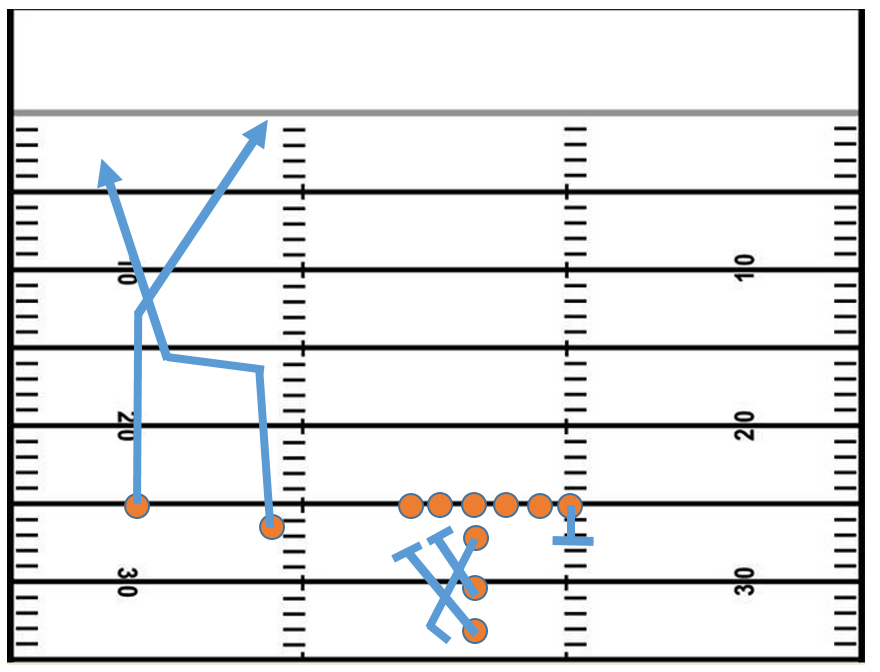
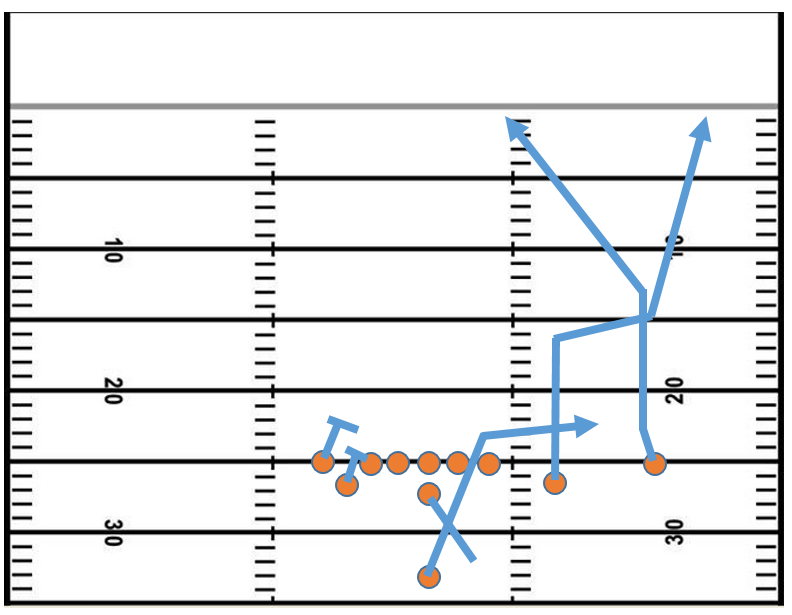
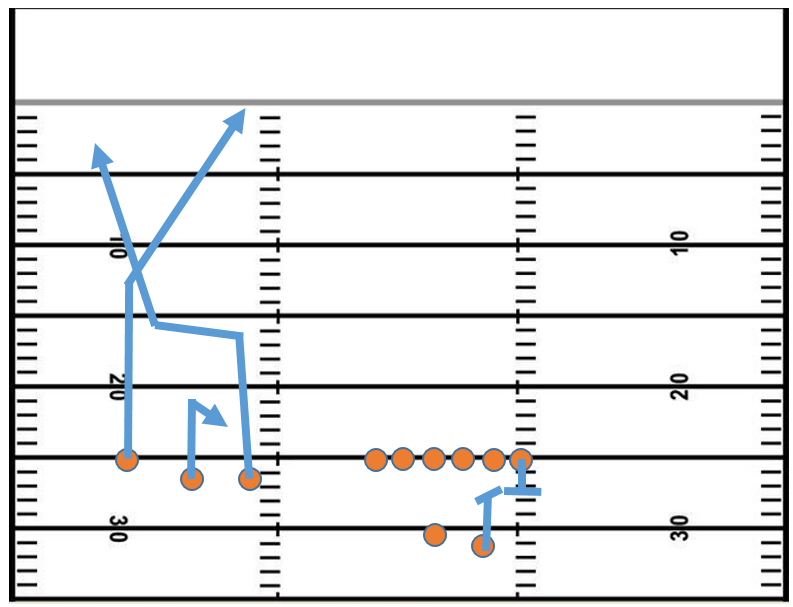
Matt Nagy's Offense is full of these "shot plays". It is his personality to attack down the field and stress defenses vertically. One of my favorite examples of this is his double move off of the scissors concept. Three of the variations that Nagy used in 2018 are drawn below.
This concept has a lot of flexibility. It can be a tag off of your base version of scissors, or you can max protect and insulate your quarterback better against a blitz. The neat part about the concept is that you do not necessarily have to major in the scissors concept for it to be effective. With the route stems looking nearly identical to the flood concept (one of the most commonly used concepts in America), you can treat that as the base look for the double move.
This double move can be quite potent against any coverage. Lets take a look at some video examples, in order of the diagrams above:
The pre-snap motion from Allen Robinson shows that the Packers will most likely be in an off-man coverage. After the ball is snapped we see that this is the case. Robinson, a tremendous route runner on a weekly basis, runs a smooth double move and keeps the defender in a trail position. With a little better protection and a little more pocket patience from the young Trubisky, the Bears were looking at 6 points.
The next video shows the play that corresponds to the second diagram from above.
This play is very similar tot he first example, but with a flat control route from the running back. Max protection will theoretically buy the quarterback the extra second he needs to get the ball off on the double move. Both Trubisky and the rolled-down safety slip on the notoriously slick Soldier Field turf. Great route from Burton to create separation and panic, leading tot he slip.
The last video shows the concept in the third diagram, out of a trips formation with an exchange of routes from the #2 and #3 receiver.
This play variation is another way to get to the same concept. Here, Nagy runs the double move with Cohen at the #3 spot in trips. The offensive staff for the Bears made a clear effort in 2018 to get Cohen favorable matchups in the pass game, and this is an example of creating an explosive attempt in that context.
Connecting on these explosive plays early on against Tampa Bay really took the visiting team out of the game mentally. Explosive plays can have this effect on teams. We are all humans with emotions (well, most of us).
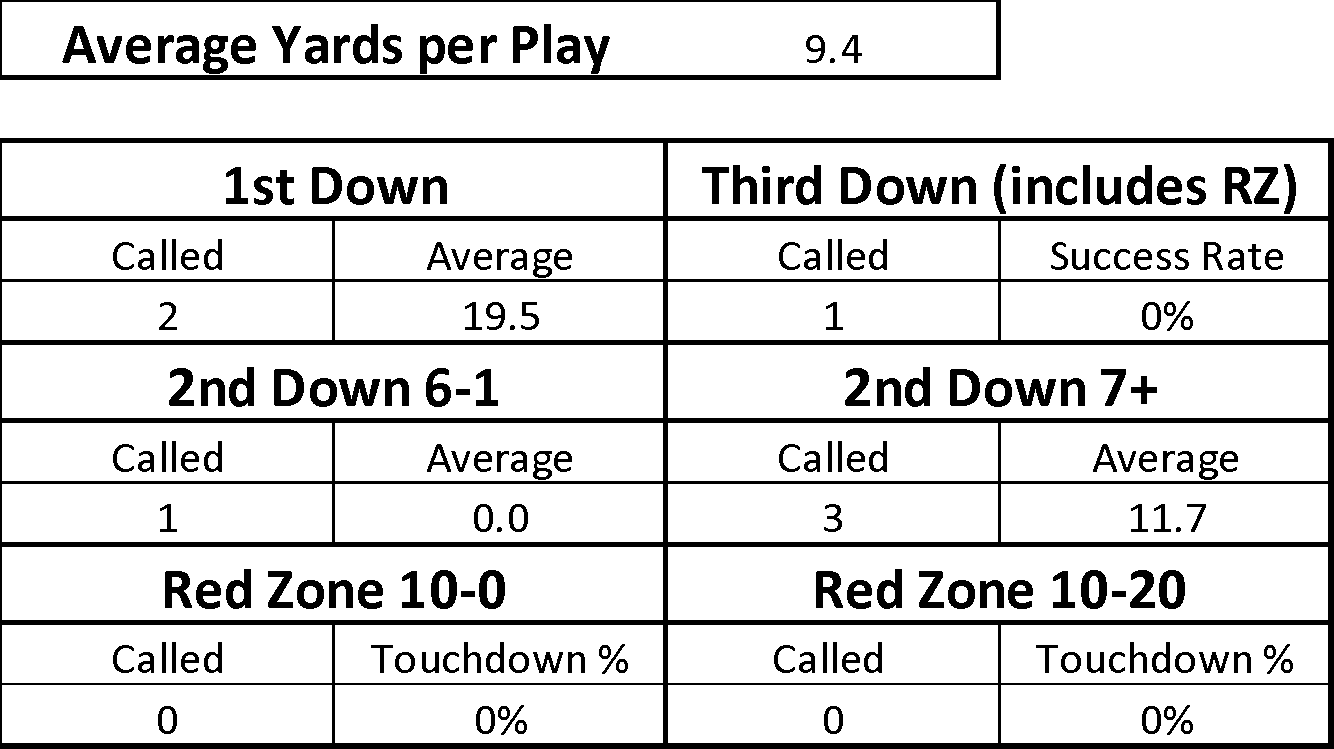
The chart below shows the overall efficiency for the concept in 2018.
Nagy had a second double move off the scissors concept that also created open explosive play opportunities for the Bears in 2018. You can find this concept diagrammed and discussed in the 2018 Bears Offensive Manual, found on Amazon. The book details Nagy's entire offense in 280 pages. Click Here to get your copy today